
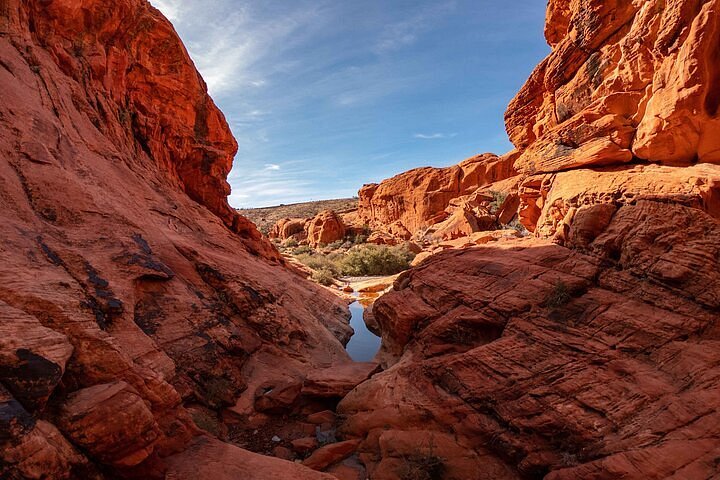
The drive: two hours west, and where the fuel stops end
Death Valley National Park's eastern edge is about 110 miles from the Strip, and the heart of the park at Furnace Creek is 130 miles, roughly two to two and a half hours. The main route is NV-160 west over the Spring Mountains to Pahrump, then Bell Vista Road (Stateline Road) west to Death Valley Junction and CA-190 into the park. A slightly longer alternative runs US-95 north to Amargosa Valley then south through Death Valley Junction; combining the two makes a loop. Pahrump is the last real town: fill the tank there, buy ice and water, and use the restroom.
Inside the park, fuel is sold at Furnace Creek and Stovepipe Wells at high prices and nowhere else on the eastern side, and cell coverage disappears almost as soon as you leave Pahrump. Download offline maps before you go; navigation apps have sent visitors down unpaved roads in this park with fatal results. Stick to CA-190, Badwater Road and Artists Drive, all of which are paved and fine for any rental car.
When to go — and when absolutely not to
Death Valley holds the record for the hottest air temperature ever reliably recorded on earth, and summer afternoons at Badwater routinely reach 120°F. From June to September the park service advises against any activity away from your car after 10 a.m., and every year visitors die from heat or from breaking down on a remote road. If your trip is in high summer, drive the loop at dawn and be out by late morning, or skip the park and go to Mount Charleston instead. Do not rely on air conditioning to save you: rental cars overheat on the long grades, and the walk from a broken-down car is what kills.
From late October to April the valley is one of the great winter destinations in America: highs in the 60s and 70s, clear air, snow on the 11,000-foot Panamint Range across the valley and, in a wet year, wildflower blooms in late February to early April that can carpet the alluvial fans in gold. Christmas week and Presidents' Day weekend are the only crowded times. Spring and autumn shoulder months (April to May, October) are warm but workable with an early start.
The one-day loop: what to see and in what order
Enter from Death Valley Junction on CA-190 and work the highlights in this order for the light and the driving distances.
- Dante's View — a 13-mile spur before you descend; a 5,500-foot perch directly above Badwater with the whole valley laid out. Cold and windy; bring a jacket.
- Zabriskie Point — five minutes from the road, the golden badlands that appear on every poster. Best at sunrise; still worth it at any hour.
- Furnace Creek — visitor centre (pay entry here, check conditions), fuel, a general store and the Ranch and Inn resorts.
- Badwater Basin — 17 miles south; walk out on the salt flats to the lowest point in North America at 282 feet below sea level. Look back for the sea-level sign on the cliff.
- Artists Drive and Artists Palette — a one-way nine-mile loop off Badwater Road on the return; the pastel mineral hills are best in the afternoon.
- Devils Golf Course and Golden Canyon — quick stops on the same road; Golden Canyon is a flat, easy mile if you want to walk.
- Mesquite Flat Sand Dunes — 25 miles northwest near Stovepipe Wells; the classic dune photograph, ideal at sunset.
Skip Scotty's Castle (long closed for flood repairs; check the park site for any reopening) and the Racetrack (requires a high-clearance vehicle and a full day of its own).
Tour versus self-drive
Small-group van and coach tours to Death Valley run from the Strip year-round, tapering in high summer, and generally last 10 to 12 hours with stops at Zabriskie Point, Badwater, Artists Drive, Furnace Creek and sometimes Dante's View or the dunes. Prices run roughly $200–$350 per person as of 2026, with lunch and park entry usually included; check operators for current rates. The case for a tour is strong here: the distances are long, the roads are empty, a breakdown is genuinely dangerous and a guide who knows the geology and the mining history adds a lot to a landscape that is silent about itself.
Self-driving is cheaper for two or more people and lets you catch Zabriskie at sunrise and the dunes at sunset, which no tour will do. It needs a reliable car, a full tank, a gallon of water per person and the discipline not to leave the pavement. For a rental, avoid the smallest economy cars in summer and check that the spare tyre is real; see our car rental guide. Scenic flights over Death Valley exist but are rare and expensive compared with the Grand Canyon; the flight tours page explains what is on offer.
Costs and time needed
Park entry is roughly $30 per vehicle for seven days as of 2026, paid at the visitor centre or automated kiosks (check the National Park Service site for current fees); the $80 America the Beautiful annual pass covers it. Fuel for a 280-mile round trip from the Strip is the main cost, and park fuel prices are steep, so arrive full. Food inside the park is limited to the Furnace Creek and Stovepipe Wells stores and restaurants, which are fine but pricey; a packed lunch from a Las Vegas grocery store is the better option. Otherwise the park is free to enjoy — every viewpoint and short walk on the loop costs nothing beyond entry.
Door to door, the loop above takes 10 to 12 hours: leave the Strip by 5 or 6 a.m., hit Dante's View and Zabriskie in the morning light, Badwater and Artists Drive by early afternoon, the dunes for sunset and Pahrump for dinner. In winter, when the light goes early, trim the dunes or Dante's View. With an overnight at Furnace Creek or Stovepipe Wells (book months ahead in season; roughly $150–$400 a night as of 2026) you get the dark-sky stars — the park is a designated International Dark Sky Park — and a second morning for Mosaic Canyon or Ubehebe Crater.
What to pack — and the rules that keep you alive
Take this list seriously. At least one gallon (four litres) of water per person even in winter, plus extra in the car; salty snacks; a hat with a brim, sunglasses and sunscreen; closed shoes with good soles (the salt flats and badlands are sharp and hot); a warm layer for Dante's View and winter mornings; a fully charged phone and a battery pack, understanding there will be no signal; a paper map or a downloaded offline one; and a full tank of fuel from Pahrump. In summer add a cooler with ice and a plan to be out of the valley floor by 10 a.m.
Rules the park stresses: stay on paved roads unless you have a high-clearance 4x4 and have told someone your route; never hike after mid-morning in summer; if your car breaks down, stay with it in the shade it makes and wait — the rangers patrol the main roads; and keep to the marked pull-outs at the salt flats, where the crust can hide brine. Our general packing list covers the rest. This is not a place to improvise.
Combining Death Valley with other stops
Death Valley does not combine well with anything on the same day; it is too far and the loop is too long. But the approach offers three worthwhile detours if you have time. Rhyolite, a ghost town just west of Beatty on the US-95 route, has a ruined bank, a bottle house and the Goldwell Open Air Museum sculptures, and costs nothing. The Amargosa Opera House at Death Valley Junction is an eccentric, wonderful relic of one woman's decades-long one-woman show and still runs performances and a hotel. And Pahrump, on the NV-160 route, has two wineries and is a fine dinner stop on the way back.
Travellers with a car and an extra day sometimes pair Death Valley with an overnight, then continue to Mount Charleston or Red Rock on the way home via NV-160, which passes the trailheads of both. If you are choosing between Death Valley and Zion for your one long day, pick by season: Zion in summer, Death Valley in winter, and either in spring and autumn. Our day trips ranking puts them side by side.


