
What the museum is
The Las Vegas Natural History Museum opened in 1991 in a former recreation centre at 900 Las Vegas Boulevard North, on the stretch of the Boulevard north of Fremont Street that the city calls the Cultural Corridor. It is a private non-profit, not a Smithsonian-scale institution, and it looks it: a modest single-storey building with a dozen galleries, a small shop and staff who clearly love the place. That is its charm. It is cheap, uncrowded and exactly the right size for two hours.
The headline gallery is the prehistoric hall, with a 35-foot animatronic Tyrannosaurus rex that roars on a timer, a Triceratops, an Ichthyosaur (Nevada's state fossil) and a decent collection of real and cast skeletons. Around it are a marine life gallery with a live shark tank and a walk-through of a coral reef, an African savannah hall of taxidermy, a wildlife gallery of Nevada and Southwest animals, a hands-on Young Scientist Center, and — the surprise — a Treasures of Egypt gallery with a full-scale reproduction of Tutankhamun's tomb built for a touring exhibition and donated to the museum. It is the closest thing Las Vegas has to a classic natural history museum, and it belongs in our museums guide for families on a budget.
Where it is and how to get there
The museum sits across the street from Cashman Center and a five-minute drive north of Fremont Street, next to the Old Las Vegas Mormon Fort State Historic Park — the oldest building in Las Vegas — and a few blocks south of the Neon Museum. From the Strip it is a 15-to-20-minute drive up Las Vegas Boulevard or I-15, and a rideshare of roughly $15 to $25 as of 2026. There is a free car park at the museum, which is a small luxury after a week of Strip garages.
Without a car, the Deuce bus runs all the way up Las Vegas Boulevard and stops near the museum; from Fremont Street it is a 20-minute walk north along the Boulevard, doable in cool months but not pleasant in summer, and the blocks between Fremont and the museum are quiet at night — take a ride after dark. See getting around without a car for the Deuce fare and how the Cultural Corridor fits into a Downtown day.
Hours, tickets and prices
The museum generally opens mid-morning and closes late afternoon daily, with holiday closures; check the official site, since a small institution's hours can change with staffing. Nothing needs booking in advance — it is a walk-up museum, and even on a school-holiday Saturday it is rarely busy.
As of 2026, adult admission has typically been in the $10 to $15 range, with lower prices for seniors, students, military and children and free entry for the very young. That makes it one of the cheapest paid attractions in the city and, for a family, roughly the cost of one adult ticket to a Strip attraction. Memberships are inexpensive and reciprocal with some other science museums, which is worth checking if you belong to one at home. Special exhibitions occasionally carry a small surcharge. Check the official site for current pricing. For other low-cost ideas, our Las Vegas on a budget guide lists the museum alongside the free and nearly free things Downtown.
Highlights and who it suits
- The T. rex. Old-school animatronic, loud, and a guaranteed hit with children between four and ten. Stand back for the roar.
- Treasures of Egypt. The reconstructed tomb of Tutankhamun with replica artefacts is far better than it has any right to be in a museum this size.
- Marine gallery. A live shark and ray tank, an eel and a walk-through reef — small but well kept.
- Young Scientist Center. Hands-on dig pits and microscopes for the under-eights.
- Nevada wildlife. Mountain lion, bighorn sheep and desert tortoise displays that explain what actually lives in the hills around you.
It suits families with children roughly three to eleven, museum-inclined adults who enjoy a small collection presented with care, and anyone doing a Downtown culture day on a budget. It does not suit visitors expecting a modern interactive science centre — for that, the Discovery Children's Museum is ten minutes away — or teenagers who have been to a big-city natural history museum and will find this quaint.
How long it takes and tips
Ninety minutes to two hours covers everything at a relaxed pace, including the shop. Families with small children may stretch it with the Young Scientist Center. Go in the morning on a weekday for the quietest galleries; school groups visit during term-time mornings, so early afternoon can actually be calmer in spring. The building is fully air-conditioned and flat, with accessible restrooms, which makes it a good hot-day retreat.
- Time the T. rex. The animatronic runs on a cycle; ask at the desk when the next roar is so the kids do not miss it.
- Combine tickets. Ask about any joint pricing with the neighbouring Mormon Fort — the state park is a couple of dollars and worth 30 minutes.
- Bring a snack. There is no cafe, only vending; the nearest food is back on Fremont.
- Check the events calendar for family science nights and the occasional dinosaur-themed weekend.
- Photography is allowed without flash in most galleries.
Pairing it with the Neon Museum and Downtown
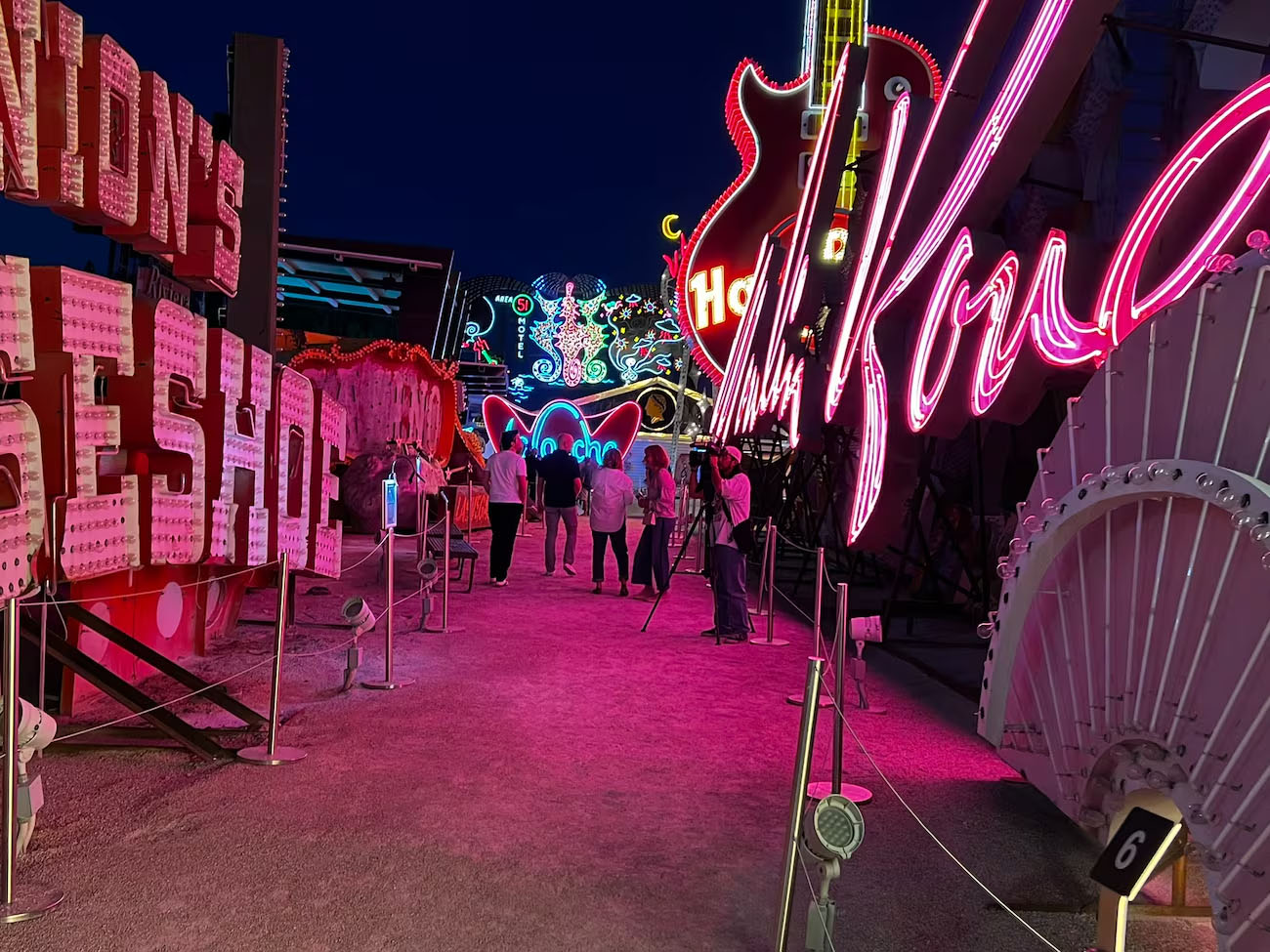
The museum is the middle stop of a natural Cultural Corridor walk. Start at the Neon Museum a few blocks north (book the timed entry; morning slots are cooler and cheaper), walk south to the Natural History Museum for the dinosaurs, spend half an hour in the Old Mormon Fort next door, then ride or walk to Fremont Street for lunch. The Mob Museum at the north end of Fremont adds a third museum for a full day; it is the most sophisticated of the three and best saved for the afternoon when the kids are done.
Families can then take on Fremont Street before the evening crowd arrives, or head to Container Park for the playground. Museum-minded adults might prefer to finish in the Arts District, ten minutes south, for a coffee and a gallery wander. Total cost for museum, fort and lunch comfortably comes in under a single Strip show ticket, which is the whole argument for the Cultural Corridor.


