
What Seven Magic Mountains actually is
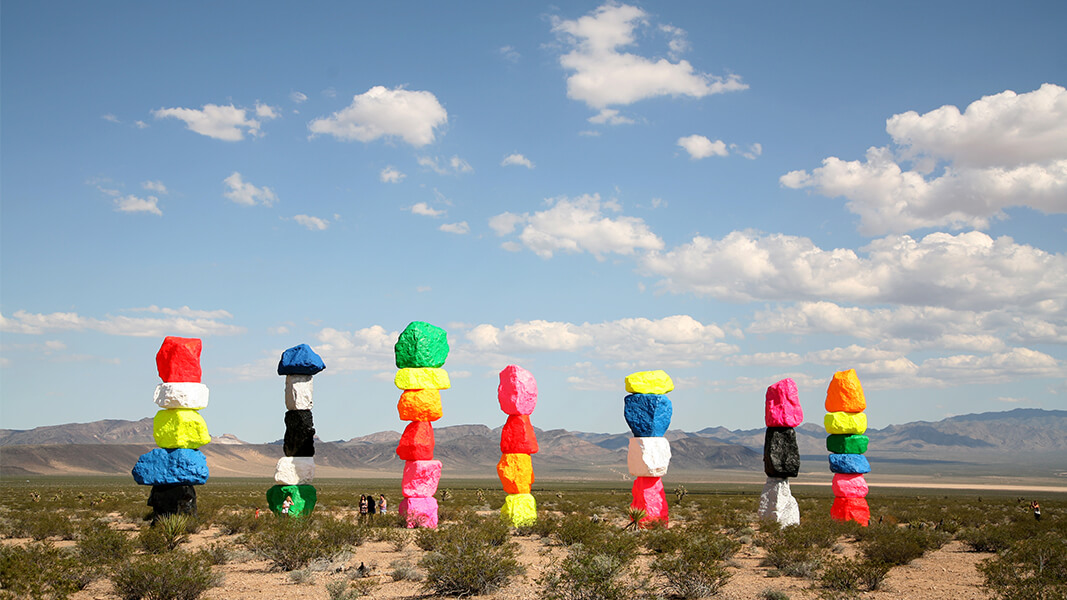
Seven Magic Mountains is a large-scale public artwork by Swiss artist Ugo Rondinone: seven totem-like stacks of locally quarried limestone boulders, each painted a different fluorescent colour and standing between 30 and 35 feet tall, set on flat desert floor with the McCullough Range behind them. It opened in May 2016 as a two-year installation produced by the Nevada Museum of Art and the Art Production Fund, proved so popular that it was extended repeatedly, and as of 2026 it remains in place — though its long-term future is still described as temporary, so check the official site before planning a trip around it.
The idea, in Rondinone's words, is a meeting point between the natural and the artificial: the desert on one side, the neon of Las Vegas on the other. In practice it is a 20-minute stop that produces some of the best photographs you will take in Nevada, and it costs nothing.
Exact directions from the Strip
The installation stands beside Las Vegas Boulevard South (the old highway) about 10 miles south of the Strip's southern end, near the Jean exit of I-15. From any Strip resort, take I-15 south for roughly 20 minutes, leave at exit 12 (Sloan Road) and turn left to cross under the freeway onto Las Vegas Boulevard, then head south about 7 miles; the towers are visible from the road on your left and there is a signed gravel lot. Alternatively stay on I-15 to exit 12 and follow the brown signs.
Total drive time from mid-Strip is 25 to 35 minutes depending on traffic. Set your navigation to "Seven Magic Mountains" — every major map app has it — rather than an address, because the surrounding land has none. If you are driving to Los Angeles, the site is a natural first stop; it is right on the way. There is no public transit, and a rideshare there and back typically costs far more than a half-day rental, so plan it as part of a car day. See our transportation guide for rental advice.
Parking, facilities and what to bring
There is a free gravel car park directly beside the road with room for a few dozen cars and a couple of tour coaches, and a short unpaved path of a few hundred feet to the towers. Cars occasionally spill onto the road shoulder on busy weekend afternoons; do not park on the highway itself. There are no restrooms, no water, no shade and no vendors of any kind — the nearest services are the gas stations at the Jean exit or back in the south Strip. Bring water, a hat and sunscreen even in winter, when the desert wind can be brutal.
The site is open around the clock and unstaffed. Drones are prohibited, and so is climbing on the stacks — the boulders are held with steel rods but the paint scuffs easily and rangers do patrol. Dogs on leads are fine. The ground is loose gravel and sand, manageable for a stroller with big wheels, tricky for a wheelchair without help.
Best light and how to get the photograph
The colours are engineered to pop against desert neutrals, so the towers look good in almost any light, but two windows stand out. The first is the hour after sunrise, when the low sun hits the east faces directly and the lot is empty. The second is the last 90 minutes before sunset, when the mountains behind turn purple and the painted stone glows; this is when the most-shared shots are taken, and also when the lot is fullest.
Midday in summer is harsh, flat and dangerously hot, and midday on a weekend means a crowd in every frame. For a clean shot with nobody in it, arrive before 8 a.m. on a weekday. The towers are spaced widely enough that you can stand between two and frame a third; a phone on a wide setting works better than a zoom here. Classic compositions: all seven in a row from the south end; a single tower with I-15 traffic blurred behind; and a low angle from the ground with the sky doing the work. Overcast days, rare as they are, are actually excellent — soft light saturates the paint.
How long to stay and what to pair it with
Most visitors are back in the car within 20 to 30 minutes. That is not a criticism; the work is meant to be seen, walked around and photographed, not studied for an afternoon. The sensible plan is to treat it as one stop on a larger loop rather than a destination.
Good pairings within a half-day:
- Heading south: continue to the Jean and Primm outlet stores (about 15 minutes) or on to the California border.
- The Strip's southern end: combine with the Welcome to Fabulous Las Vegas sign on the way back, which is on the same boulevard, and lunch in the south Strip.
- Art day: pair with the Arts District downtown for galleries and the monthly First Friday event, covered in our free things guide.
- Desert day: it is on the opposite side of the city from Red Rock Canyon, so combine it with a morning at Red Rock only if you are happy with 90 minutes of total driving.
Tours that include it
Several Las Vegas operators run short guided trips that stop at Seven Magic Mountains, usually bundled with the Welcome sign and a Strip drive, or as a leg of a longer day that continues to Hoover Dam or into the desert. Prices for a half-day combination tour run roughly $40–$90 per person as of 2026, check operators for current rates; a standalone stop is rarely offered because the visit is so short. Photo-oriented tours timed for golden hour are the most worthwhile version.
If you are not renting a car and it is the only thing pulling you out of the city, a tour is the practical way to get there. If you are renting a car for any other reason — Hoover Dam, Red Rock, a drive to Los Angeles — do it yourself and save the money. For more budget-friendly guided options see tours under $50.
Mistakes to avoid
The most common error is arriving at 2 p.m. in July. The site has no shade, the gravel radiates heat and the towers are washed out by high sun; you will take a worse photo and feel worse taking it. Go early or late. The second is expecting more than there is: it is seven painted rock stacks in a field, magnificent for 20 minutes, and people who plan a three-hour outing around it come away underwhelmed. Fold it into another drive.
Check the status before you go. The work was always described as temporary, and although it has been extended well past its original 2018 end date, the official site is the only reliable source on whether it is still standing and whether any restoration work has closed access. Finally, resist the urge to touch up the paint yourself or leave anything at the base — the stacks are inspected and maintained, and offerings and graffiti are removed. Leave it as you found it so the next carload gets the same shot you did.


