
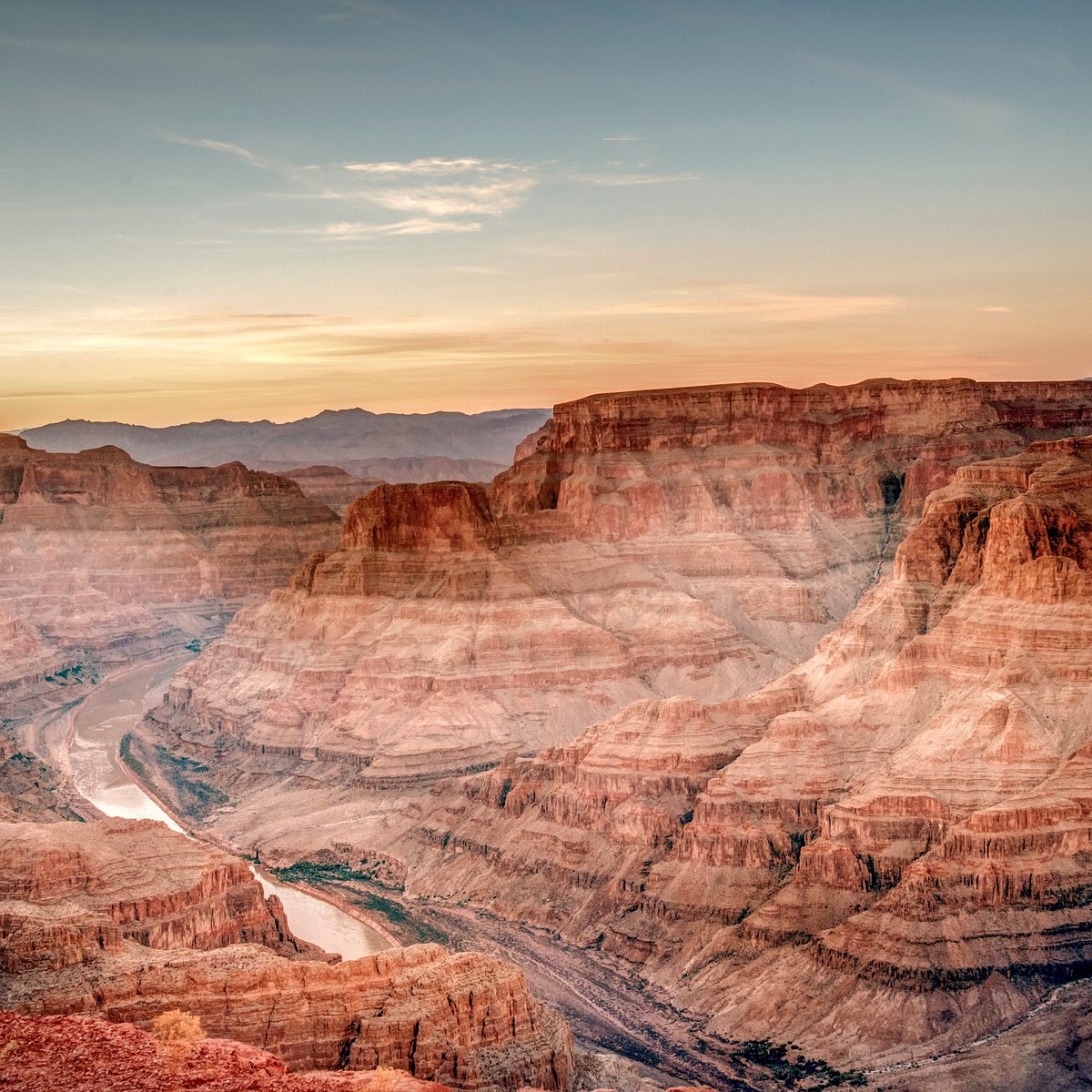
West Rim versus South Rim: the decision that matters
There is no single "Grand Canyon" trip from Las Vegas. The West Rim is on the Hualapai Reservation, about 125 miles and 2.5 hours away, outside the national park. It is where the Skywalk glass bridge is, where helicopters land on the canyon floor and where almost every short tour goes. The canyon is narrower and shallower here than in the famous photographs, but it is still a mile-deep gorge and the Colorado is visible below.
The South Rim is Grand Canyon National Park proper — Mather Point, Bright Angel Trail, the historic village — about 275 miles and 4.5 hours each way. It is the view you have seen on every poster, ten miles across with layered walls receding forever, and there is no comparison in scale. The trade-off is a 14- to 16-hour day if you do it by coach. The honest rule: if you have one day and want the Grand Canyon experience with the least travel, go West. If the canyon is a bucket-list item and you have the stamina or a second night, go South. The North Rim is too far for a day trip and closed in winter.
Helicopter tours: the fastest and most expensive route
Helicopters make the West Rim a half-day. The classic product flies you from an air terminal near LAS or Boulder City over Lake Mead and Hoover Dam, along the canyon and — on landing tours — down onto a plateau near the river, where you get 20 to 30 minutes and a sparkling-wine picnic before flying back. The whole thing runs three and a half to four and a half hours door to door, and the views of the dam and the canyon from the air are, without exaggeration, the best 40 minutes of many people's trips.
As of 2026, air-only West Rim flights generally start in the $300 to $450 range and landing tours run roughly $450 to $700 per person, with sunset and Strip-flyover add-ons above that; check the operators' sites, because fuel surcharges and seasons move prices. Papillon, Maverick and Sundance are the established names. Seats are assigned by weight for balance, so you may not sit beside your partner, and passengers over a certain weight pay a surcharge. Book a morning flight for calmer air and clearer light, and give yourself a buffer — flights are cancelled for wind, not rescheduled around your dinner reservation.
Bus and small-group tours
Coach tours are the workhorse. A West Rim bus day runs 10 to 12 hours: pick-up around dawn from Strip resorts, a photo stop at Hoover Dam or the bridge, arrival at Grand Canyon West by late morning, three to four hours on the rim using the Hualapai shuttle between Eagle Point, Guano Point and the ranch, then the drive home. Skywalk admission, a helicopter descent or a pontoon boat on the river can be added. As of 2026 West Rim coach tours generally cost in the $150 to $250 range before add-ons.
South Rim coach days run 14 to 16 hours with about three hours in the park, usually at Mather Point and Grand Canyon Village, and typically cost $200 to $300. Small-group van tours in both directions cost more but skip the hotel-collection circuit that can add an hour each way on a big coach. An alternative for the South Rim is a fixed-wing flight to the Grand Canyon airport in Tusayan followed by a ground tour, which cuts the day to about eight hours at a price closer to a helicopter. Whatever you book, read the itinerary for actual time at the rim; the number varies wildly. Our tickets hub has notes on comparing operators.
Driving yourself
Self-driving to the West Rim is about 2.5 hours: US-93 south past Hoover Dam to Dolan Springs, then Pierce Ferry Road and Diamond Bar Road to Grand Canyon West. The last stretch is paved now, so any rental car will do. Once there you cannot drive the rim; you buy a Hualapai general admission ticket, which includes the hop-on shuttle between viewpoints, and add the Skywalk or other activities. As of 2026 general admission has generally been in the $50 to $70 range with Skywalk on top; check the Grand Canyon West site.
The South Rim is a 4.5-hour drive via Kingman and Williams on I-40, then AZ-64 north into the park, where the national park entrance fee applies per vehicle. It is a long but painless drive and an overnight in Tusayan or Williams turns it into the best two-day excursion from Las Vegas. Driving yourself means sunrise at the rim, stops at Hoover Dam and on Route 66 in Seligman or Kingman, and none of the coach timetable. Watch fuel — services thin out on Pierce Ferry Road — and remember Arizona time; see the transportation hub for rental advice.
The Skywalk: worth it or not?
The Skywalk is a horseshoe-shaped glass-floored walkway cantilevered 70 feet out from the rim at Eagle Point, with the canyon floor roughly 4,000 feet below. It is an engineering novelty and it does deliver a stomach-drop moment the first time you look down. The rules take the edge off for many people: no phones, cameras or bags are allowed on the glass, you wear shoe covers, and photographs are taken by staff and sold afterwards. As of 2026 the add-on has generally been in the $25 to $35 range on top of general admission.
Our view: if you are already at the West Rim, the Skywalk is a reasonable 20-minute add-on, especially for first-timers and kids, but it is not the reason to choose the West Rim over the South. Guano Point, a short shuttle ride away, offers a free walk out onto a rocky promontory with an arguably better panorama and the remains of a 1950s mining tramway. Many visitors rate Guano Point higher. If the photo policy bothers you, skip the glass and spend the time and money on the helicopter descent to the river instead.
Timing, seasons and what to bring
Spring (March to May) and autumn (September to November) are the sweet spots: mild at the rim, clear air, manageable crowds. Summer at the West Rim is brutal — well over 100°F with almost no shade — while the South Rim, at 7,000 feet, is 20 degrees cooler and prone to afternoon thunderstorms in July and August. Winter brings snow and occasional road closures at the South Rim and cold, crisp, empty days at the West. Any season, the canyon is at its best in the first and last two hours of light, which a coach day almost never gives you.
Bring more water than you think, a hat, sunscreen and layers — the rim can be 30°F cooler than the Strip in the morning. Wear real shoes; every viewpoint involves uneven rock. Motion sickness tablets help on the helicopter and the winding Diamond Bar Road. Check the Arizona time situation: Arizona does not observe daylight saving, but the Navajo Nation does, and tour pick-up times are in Las Vegas time. If Hoover Dam is a priority, do it separately — our Hoover Dam guide explains why combo stops disappoint.
How it fits the rest of a trip
A Grand Canyon day consumes a day: even the helicopter half-day leaves you drained, and a coach day means a 5am alarm and a 9pm return. Put it in the middle of the trip, not the day after a late night and not the day before a flight. Pair it with a slow evening — a fountain show and an early dinner rather than a nightclub. If you are on a short trip and unsure, remember that Red Rock Canyon and Valley of Fire deliver dramatic red desert in a half-day each with almost no travel, and for many visitors they scratch the same itch.
Budget-wise, the canyon is the largest single line on most Las Vegas activity budgets. A couple can easily spend $1,000 on a landing helicopter tour or $400 on a coach day. Decide what you are paying for — the flight itself is half the experience of a helicopter tour, while a coach trip is paying for rim time — and compare the rest of your plans in our day trips overview before you commit.


