
How rideshare works on the Strip
Uber and Lyft both operate fully in Las Vegas and have more drivers per square mile on the Strip than almost anywhere in America. The wrinkle is that you cannot get picked up at the curb on Las Vegas Boulevard. Every major resort has a designated rideshare pickup zone, usually at a side entrance, in a parking garage or by the convention area, and the app will route you there automatically when you request. Finding it can take five to ten minutes of walking through the casino, so request the ride once you are near the zone rather than from your room.
Drop-offs are easier: drivers can generally use the main porte-cochère or a side entrance. At a few resorts (the Venetian, Caesars, Bellagio, Wynn) the rideshare zone is a long walk from the Strip-facing entrance, so if you are heading out to a specific restaurant or show, check where the nearest zone is — sometimes it is closer at the neighbouring resort. Tip drivers in the app; 15–20% is normal.
What rides actually cost
As of 2026, and outside surge periods, expect these approximate ranges: a short Strip hop (Bellagio to Venetian, say) $9–15; a longer one (Mandalay Bay to Wynn) $15–25; Strip to Fremont Street $18–30; airport to the Strip $15–30 including the airport fee. Prices climb steeply for larger vehicles (UberXL, Lyft XL) and for premium tiers, which you rarely need. Both apps show the price before you confirm, so compare — Uber and Lyft frequently differ by 20–30% for the same trip at the same moment.
Surge pricing is the budget-killer. It hits hard when a big show lets out, after fights and festivals, and on Friday and Saturday nights between roughly 11 p.m. and 2 a.m. A $15 ride can quote at $40–60. The counter-moves are simple: walk one or two resorts away from the event, wait fifteen minutes, or switch to the taxi rank, where the meter does not surge. For most short trips, the taxi line outside the resort is the better deal in surge conditions.
Taxis: still everywhere and still useful
Every casino resort has a taxi rank at its main entrance, usually staffed by a doorman who loads you into the next cab in seconds. The metered fare includes a flag-drop of a few dollars, a per-mile rate and a slow-traffic time charge; a Strip-to-Strip ride typically comes to $12–25 including tip, and a credit-card surcharge often applies. Rates are set by the Nevada Taxicab Authority and posted inside every cab. Cabs cannot be hailed on the street on the Strip — go to a rank.
Taxis win in three situations: surge, groups of four with bags, and short hops from a resort entrance where the rideshare zone is far away. They lose on price for longer trips in normal conditions and on convenience (you need to be at a rank). Nearly all cabs now take cards, but a few drivers will "forget" the reader works; insist. Airport-specific taxi advice, including the long-hauling scam, is in our airport guide.
Finding the pickup zone at major resorts
Zones move occasionally, and the app is the authority, but as a working guide: Bellagio uses the north valet by the Spa Tower; Caesars Palace uses the Forum Shops valet entrance; The Venetian and Palazzo use the garage off Sands Avenue or the Palazzo valet; Wynn and Encore have zones near the tower entrances off the main drive; MGM Grand uses the west garage area; Park MGM, Aria and Cosmopolitan each have a signed rideshare level in their garages; Mandalay Bay uses the convention centre side; Resorts World uses a dedicated area near the west entrance. At every resort, ask any casino employee — they are asked constantly and will point.
Downtown, the Fremont Street Experience is pedestrianised, so pickups are on the side streets (Carson Avenue, Ogden Avenue) and at the Fremont East end; the app will place you. At AREA15, the Sphere and Allegiant Stadium there are managed rideshare lots with attendants after events; expect a wait of 20–40 minutes for a driver after a stadium show.
Safety, scams and etiquette
Rideshare in Las Vegas is safe and heavily used, but a few things are worth stating. Confirm the licence plate and the driver's name before getting in — at busy pickup zones, people take the wrong car constantly. Never accept an unsolicited "ride" from someone approaching you in a garage or at the airport; licensed taxis are at ranks and rideshare drivers do not solicit. Share your trip in the app if you are travelling alone late.
Nevada law does not require rideshare drivers to carry car seats, and most do not. Families with small children should bring a travel car seat or use a pre-booked car service that provides one. Tipping is expected for both taxis and rideshare; for taxis, $2–5 on a short ride or 15–20% on a long one. And a small point that saves arguments: if a taxi driver offers to take you to a "better" club or restaurant, decline — it is a kickback arrangement, not advice.
When not to use a car at all
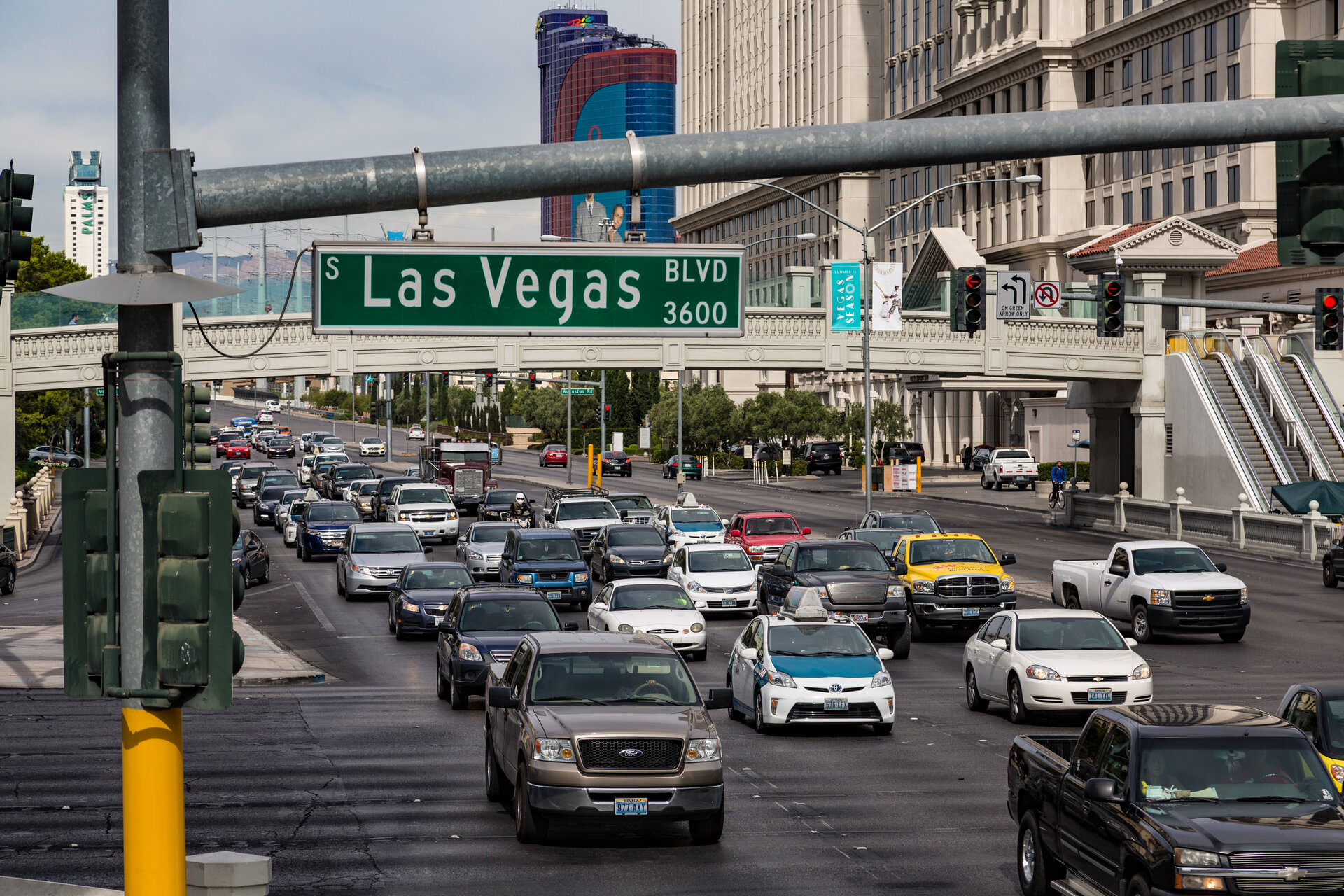
Rideshare is not always the fastest way. Between about 5 p.m. and midnight on weekends, Las Vegas Boulevard between Tropicana and Spring Mountain crawls, and a two-resort ride can take longer than the walk once you add the trek to the pickup zone. In those windows, use the free trams where they exist, the Monorail on the east side, or the pedestrian bridges. The Deuce is stuck in the same traffic as everything else.
Drivers know the back roads — Frank Sinatra Drive on the west side and Koval Lane on the east run parallel to the Strip and are often empty while the Boulevard is jammed. If your driver heads that way it is not long-hauling; it is competence. For the bigger picture of when to walk, ride or roll, see getting around without a car.
Car services and limos
Pre-booked black cars and limousines are a Las Vegas institution, and for the right group they are cheaper than they sound. A stretch limo from the airport for six people at $90–150 all-in is not much more than two rideshares in surge, and a booked sedan for a dinner reservation at a specific time removes the pickup-zone scramble. Book through your hotel concierge or an established local operator, not through a tout at the airport. Uber and Lyft also offer premium tiers that fill the same role for one-off trips.