
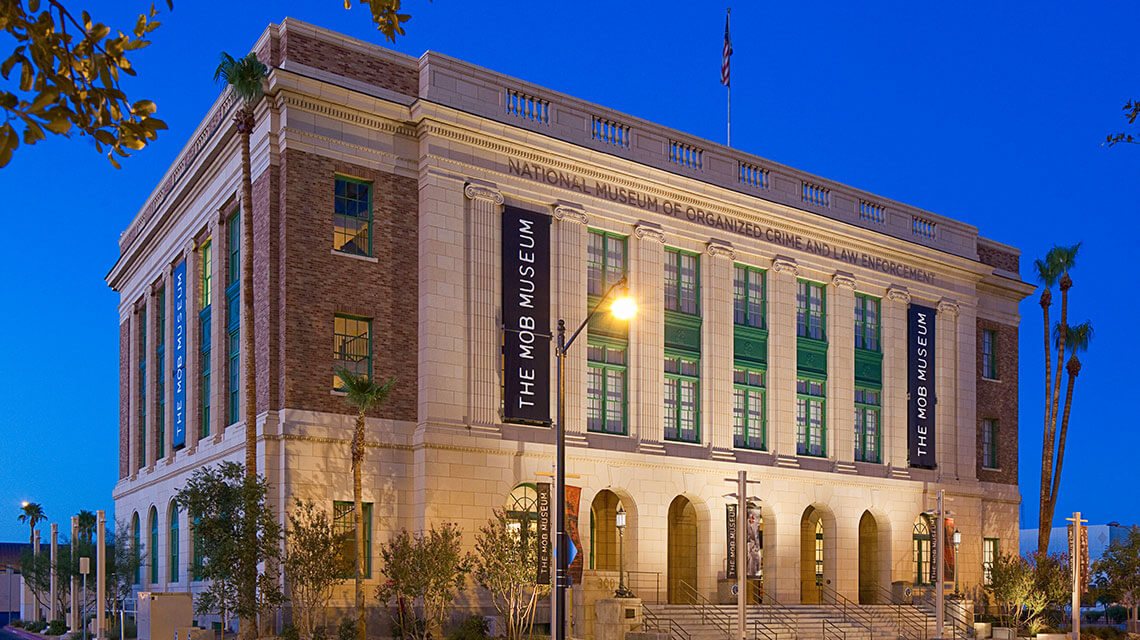
Why the Mob Museum is the one museum everyone should do
The Mob Museum — officially the National Museum of Organized Crime and Law Enforcement — opened in 2012 in the former federal courthouse and post office at 300 Stewart Avenue, two blocks off Fremont Street. The building matters: the second-floor courtroom is where one of the 1950 Kefauver Committee hearings into organised crime took place, and it has been restored so you sit in the same room watching the footage. Few museums get to tell their story in the place it happened.
What makes it work is balance. Half the museum is about the mob — Prohibition, the Five Families, the Chicago Outfit, Bugsy Siegel, the Stardust and Tropicana skims that funded the modern Strip. The other half is about the people who chased them: wiretaps, FBI surveillance vans, the witness protection programme, the RICO Act. It is dense, well-designed and unsentimental, and it explains how Las Vegas became Las Vegas. If you have time for one indoor attraction Downtown, this is it.
How the museum is laid out
You start at the top and work down. The third floor covers the origins of organised crime — immigration, Prohibition, the rise of the syndicates — and holds the museum's single most famous object: a section of the actual brick wall from the St Valentine's Day Massacre in Chicago, bullet holes intact. The second floor is the courtroom and the mob's move west: casino skimming, the Flamingo, the Kefauver hearings and the wave of federal prosecutions in the 1980s that finally pushed the mob out of Las Vegas.
The first floor deals with modern organised crime — cartels, trafficking, cybercrime — and law enforcement's response, and it is here that the interactive add-ons live. The basement holds The Underground, a working speakeasy and distillery. Signage is good and there is a free audio guide via your phone; most visitors need two to three hours to do it justice without skimming, and history-minded visitors can spend four.
Tickets and add-on experiences
As of 2026, general admission is priced roughly in the $30s for adults, with discounts for Nevada residents, seniors, military, students and children; a "deluxe" ticket bundles the interactive experiences for something in the $40s to $50s. Check the official site for current prices and hours — the museum is usually open every day, into the evening.
The paid add-ons, each about 20–30 minutes:
- Crime Lab — a hands-on forensics session: fingerprinting, blood-spatter analysis, DNA basics. Good for teens and anyone who watches crime procedurals.
- Firearm Training Simulator — the use-of-force simulator used to train officers, with modified real weapons that fire laser rounds at a screen. Genuinely tense and the most-recommended add-on.
- Distillery tour and tasting — a short look at the basement moonshine still with a sample at the end; 21+.
If you buy only one, take the simulator. All three sell in timed slots and can fill on weekends, so book with your admission.
The Underground speakeasy
The Underground is the museum's basement bar and it is better than a museum bar has any right to be. It is styled as a 1920s speakeasy — low ceilings, brick, a small stage with live jazz on some nights — and it makes classic-era cocktails plus its own house moonshine and a small-batch bourbon from the on-site distillery. There is a separate street entrance on the west side of the building and a "password" posted on the museum's social channels, so you can drink there without buying a museum ticket.
It is open into the late evening, well after the galleries close, which makes it a smart last stop on a Downtown night: museum in the late afternoon, dinner on Fremont East, back to The Underground for a nightcap. Prices sit in the normal Downtown cocktail range rather than Strip prices. It is 21+ and can be busy at weekends; for more Downtown bars see our Shows & Nightlife hub.
Is it suitable for children?
The museum does not set an age limit, but it is honest about its subject. There is graphic content: crime-scene photographs, the Massacre wall, footage of executions and beatings, and exhibits about trafficking and drugs. Younger teens interested in history or true crime tend to be absorbed; children under about ten will find much of it either boring or upsetting. The Crime Lab add-on is the exception and works well from around age eight.
If you are travelling with a mixed-age group, the practical split is: adults and older teens do the full museum, younger kids and one adult do the Crime Lab and the Fremont Street canopy or an ice cream on Fremont East, then regroup. For other family-friendly options see things to do with kids.
Getting there and combining it with Downtown
The museum is a five-minute walk from the east end of the Fremont Street Experience and about 15 minutes on foot from the Neon Museum. From the Strip, a rideshare takes 15–20 minutes and costs in the mid-teens to $20s as of 2026; the Deuce bus is cheaper and slower. There is paid parking in nearby city garages and a limited lot, see our Transportation guide for Downtown parking.
A well-paced Downtown day: arrive at the Mob Museum around 2pm, allow three hours including one add-on, walk to Fremont East for dinner, then the Neon Museum at dusk or the canopy shows. In summer this sequence keeps you indoors through the hottest hours, which is exactly why we recommend it in our indoor things to do guide.
Insider tips
- Go on a weekday afternoon. Weekend mornings bring tour groups; by 3pm on a Tuesday the courtroom is nearly empty.
- Start on the third floor and do not skip the introductory film — it frames everything after.
- Book the simulator slot for the end of your visit so you are not watching the clock in the galleries.
- Look for the Las Vegas-specific exhibits on the second floor — the skim, the Tony Spilotro story and the FBI "Strawman" case are the bits you will not find elsewhere.
- Pair with Fremont Street, not the Strip. The museum is a Downtown day; trying to squeeze it between Strip attractions wastes an hour in traffic.
- Ask about the Nevada-resident and evening discounts if you qualify; check the official site for the current list.


