
How to pick a day trip: distance, season and car
Everything within three hours of Las Vegas is worth seeing, but not on the same day or in the same month. The first filter is drive time: Red Rock Canyon is 30 minutes, Hoover Dam 45, Valley of Fire an hour, Mount Charleston an hour, Death Valley and Zion two to two and a half hours, and the Grand Canyon's South Rim four and a half. Anything over two hours means a dawn start and a long day.
The second filter is season. Death Valley and Valley of Fire are winter and spring destinations; Mount Charleston is a summer escape and a winter snow day; Zion is best in spring and autumn and very crowded in summer. The third is transport. A rental car unlocks all of them at your own pace; the Transportation hub covers rentals and parking. Without a car, coach and small-group tours reach every one of these, and for the Grand Canyon a tour is usually the smarter choice anyway.
The near-Strip classics: Hoover Dam, Red Rock, Valley of Fire
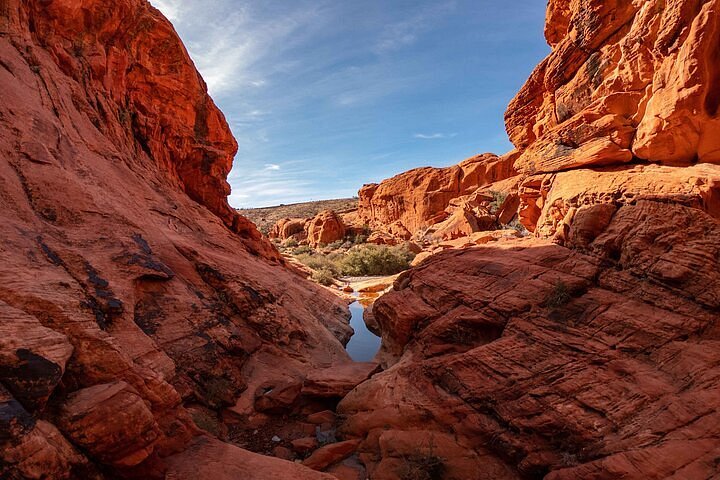
If you have one free day, make it one of these three, all covered in their own guides. Hoover Dam is the most iconic: 45 minutes by car, a walk across the top, the guided Powerplant tour and a stop in Boulder City for lunch. It is a half-day plus and pairs naturally with Lake Mead. Red Rock Canyon is the easiest: 30 minutes west, a 13-mile scenic loop, short hikes and a timed-entry reservation in the busy season. It fits into a morning before the heat.
Valley of Fire is the most beautiful: an hour northeast, with the Fire Wave and White Domes trails and rock more vivid than anything at Red Rock, but trails close in summer heat and it demands an early start from October to April. For the Grand Canyon, read the dedicated guide before deciding between the close, privately run West Rim and the far, spectacular South Rim.
Death Valley National Park
Death Valley is 120 miles and about two hours west via Pahrump and Death Valley Junction, and it is the most otherworldly day out of Las Vegas. Badwater Basin is the lowest point in North America at 282 feet below sea level, a white salt flat you walk out onto; Zabriskie Point and Dante's View give the classic overlooks; Artists Drive is a one-way loop through hills coloured by minerals; the Mesquite Flat sand dunes near Stovepipe Wells glow at sunset. A national park entry fee applies per vehicle (as of 2026, check the park site).
Visit from November to March. In summer the valley floor routinely exceeds 120°F, the park advises against any hiking after 10 a.m., and a breakdown becomes dangerous. Fill the tank in Pahrump, carry a gallon of water per person, and expect little or no phone signal. A realistic loop is Badwater, Artists Drive, Zabriskie and the dunes with a stop at Furnace Creek, back in Las Vegas by dark, roughly 11 hours. Tours run in the cool months for those without a car.
Zion National Park
Zion is 160 miles northeast in Utah, about two and a half hours via I-15 to Springdale, and it is a real, do-able day trip if you leave by 6 a.m. and accept a late return. For most of the year private cars cannot drive Zion Canyon Scenic Drive; you park in Springdale or at the visitor center and ride the free park shuttle, which stops at the trailheads. Highlights that fit a day: the Riverside Walk to the mouth of the Narrows, the Emerald Pools, Canyon Overlook Trail by the tunnel, and the Court of the Patriarchs viewpoint.
Angels Landing needs a permit won by lottery and a full day; the Narrows needs river gear and is a wade, not a walk. Spring and autumn are ideal; summer is hot and crowded, with parking gone by 8 a.m.; winter is quiet and lovely with some trail ice. National park entry is per vehicle (as of 2026, check the park site). Note the one-hour time change into Utah in the parts of the year when Nevada and Utah differ. If you can spare a night, Springdale is a much better base than a same-day return.
Lake Mead National Recreation Area
Lake Mead is the reservoir behind Hoover Dam, 30 to 45 minutes southeast, and its main draw is water in a desert. Boulder Beach and the marinas near Boulder City are the closest access; you can rent kayaks and paddleboards, take a boat trip, or drive the Lakeshore Road and Northshore Road for views of red rock reflected in blue water. The Historic Railroad Trail from the Lake Mead visitor center to the dam is a flat, easy 3.7 miles each way through five tunnels and one of the best walks in the area.
A per-vehicle entry fee applies (as of 2026, check the park site). The lake has dropped dramatically in the drought years, so expect a wide white "bathtub ring" and shorelines far from older maps; marinas move with the water. The Black Canyon below the dam, reached by guided kayak tours launching from near the dam base, is the standout water experience: hot springs, slot canyons and calm emerald water. Pair Lake Mead with Hoover Dam for a full day, or do the railroad trail at sunrise before the dam tour.
Mount Charleston and the Spring Mountains
Mount Charleston is the surprise: a 11,916-foot peak 45 minutes to an hour northwest of the Strip where the temperature runs 20°F to 30°F cooler than the city. In July, when the Strip is 110°F, Kyle Canyon is a pleasant 80°F with pine forest, picnic sites and trails. Cathedral Rock is a steep 3-mile round trip with a big view; Mary Jane Falls is a 3-mile hike to a seasonal waterfall; the Bristlecone Trail in Lee Canyon is a gentle 6-mile loop among ancient trees. There is no fee to drive up; some trailheads charge a small parking fee.
In winter Lee Canyon has a small ski and snowboard area, and the whole range gets snow that families from Las Vegas drive up to play in. The Spring Mountains Visitor Gateway at the bottom of Kyle Canyon has maps and current conditions. There are a couple of lodges and a restaurant on the mountain. It is the ideal half-day escape in summer, and it is what to do when the desert parks are too hot; you can be up, hike, lunch and back at the pool by 3 p.m.
Tour or drive yourself?
Drive yourself for Red Rock, Hoover Dam, Lake Mead, Mount Charleston and Valley of Fire: they are close, well-signposted and better at your own pace. Rental cars are plentiful at LAS and at Strip rental desks; check the Transportation hub for parking fees, which are now charged at most Strip resorts. Take a tour for the Grand Canyon, where a coach or helicopter removes nine hours of driving, and consider one for Death Valley and Zion if you would rather not drive back tired in the dark.
Tour pricing (as of 2026, check operators) runs from budget coach trips to Hoover Dam in the tens of dollars, through small-group van tours to Valley of Fire, Zion or Death Valley in the low-to-mid hundreds, up to helicopter and combination trips in the high hundreds. Our tours under $50 guide lists the value end. Whatever you choose, book desert trips for the first days of your stay when you are fresh, and avoid the day before an early flight.
Rankings by trip type and time available
Half a day, no car: Hoover Dam coach tour or Red Rock shuttle tour. Half a day with a car: Red Rock scenic loop and a short hike, or Mount Charleston in summer. Full day with a car, cool season: Valley of Fire in the morning and Lake Mead's Northshore Road back, or Death Valley. Full day, any transport, bucket list: the Grand Canyon, ideally the South Rim by coach or the West Rim by helicopter.
Two days with a car: Zion with a night in Springdale, returning via Valley of Fire. Summer: Mount Charleston or Red Rock at dawn only; skip Death Valley entirely. With kids: Hoover Dam and Boulder Beach, or Red Rock's visitor center and the Calico Hills. Check the kids guide and itineraries for how these slot into a full trip, and remember every desert outing needs more water, sunscreen and fuel than you think.


