
What the Strip actually is
The Las Vegas Strip is the stretch of Las Vegas Boulevard South that runs roughly 4.2 miles from the Mandalay Bay and the "Welcome to Fabulous Las Vegas" sign in the south to the Strat tower in the north. Almost none of it is inside the City of Las Vegas; it sits in the unincorporated towns of Paradise and Winchester, which is why the police cars say Clark County and why Downtown, five miles north, is a separate place entirely.
What makes it unusual is scale. The resorts along it are among the largest hotels on the planet, several with 3,000 to 7,000 rooms, each with its own casino, theatre, pool complex, shopping mall and dozens of restaurants. A single resort can take an hour to cross. That scale is the thing first-time visitors consistently underestimate, and it drives every practical decision on this site: where to stay, how to get around and how many things you can realistically fit into a day.
Think of the Strip less as a street and more as a chain of self-contained cities connected by wide sidewalks, pedestrian bridges and a handful of trams. Once you see it that way, the planning gets easier.
How it is laid out: South, Center and North
Locals and this site divide the Strip into three sections, and each has a distinct character.
- South Strip — from Mandalay Bay north to MGM Grand and Park MGM, around Tropicana Avenue. Closest to the airport and Allegiant Stadium, dominated by MGM Resorts properties, linked by a free tram, generally better value.
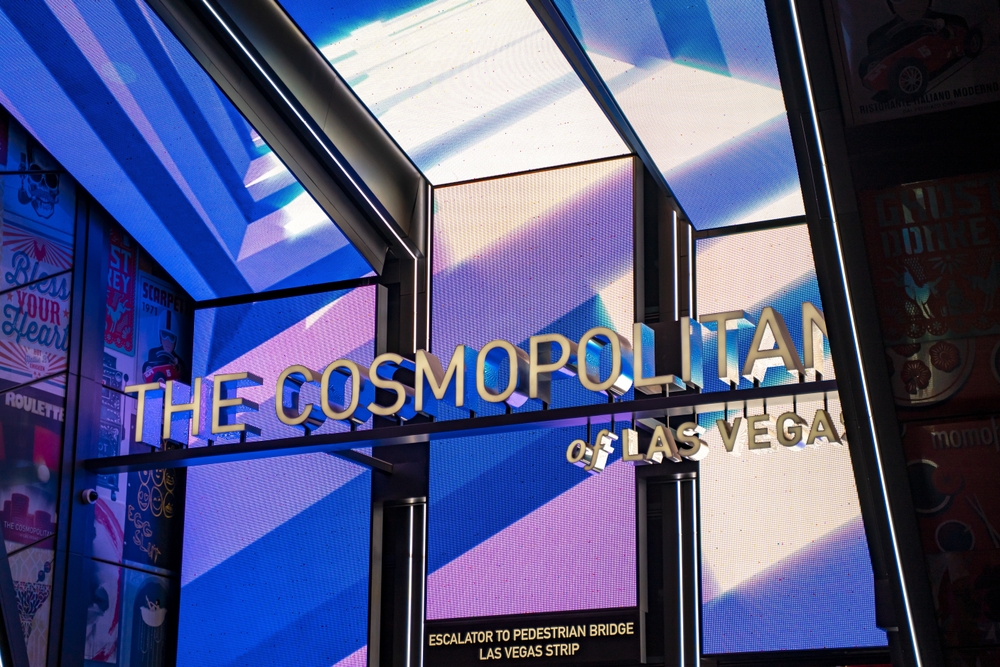
- Center Strip — from Aria and the Cosmopolitan up through Bellagio, Caesars Palace, the Flamingo and the LINQ, centred on the Flamingo Road intersection known as the Four Corners. The densest, most walkable and most expensive stretch.
- North Strip — from the Venetian and Wynn past Resorts World, Fontainebleau and the convention center to the Sahara and the Strat. Newest resorts, biggest gaps between them, home to Sphere.
The boundaries are fuzzy. The Venetian is often called Center Strip and Park MGM is sometimes lumped in with the centre. What matters is the practical reality: the Center Strip is where you can walk to the most in the least time, and the ends require transport.
The walking reality
The Strip looks compact on a map because the resorts are enormous and the map only shows their footprints. In practice, walking from Mandalay Bay to the Strat takes two to three hours without stopping, and the sidewalk route between two neighbouring resorts is often 15 to 20 minutes because you have to climb pedestrian bridges, detour around driveways and cross through a casino floor.
Some honest benchmarks: Bellagio to Caesars Palace is about 10 minutes. Bellagio to the Venetian is 25 to 30. MGM Grand to Bellagio is 25. The Venetian to Resorts World is 20 to 25, much of it past empty lots. Add summer heat, where afternoon pavement temperatures exceed 110°F from June to September, and a plan that looks like a stroll becomes an ordeal.
Our rule of thumb: plan on foot within your section, and use the monorail, Deuce bus, trams or a rideshare to change sections. Wear real shoes. A typical Strip day is 15,000 to 25,000 steps even when you think you are taking it easy.
The resort clusters that matter
Ownership shapes the Strip more than geography, because sister resorts share trams, loyalty programmes, parking policies and walkways.
- MGM Resorts owns most of the South Strip (Mandalay Bay, Luxor, Excalibur, New York-New York, Park MGM, MGM Grand) plus Aria, Vdara, the Cosmopolitan and Bellagio in the centre. Its MGM Rewards programme and free trams tie them together.
- Caesars Entertainment holds the Center Strip east side: Caesars Palace, the Cromwell, Flamingo, the LINQ, Harrah's, Horseshoe, Paris and Planet Hollywood. These are linked by walkways and Caesars Rewards.
- Wynn Resorts runs Wynn and Encore. Las Vegas Sands' former properties, the Venetian and Palazzo, are now under separate ownership with Sphere next door.
- Independent newcomers Resorts World and Fontainebleau anchor the North Strip; the Hard Rock is rising on the old Mirage site.
Knowing the clusters helps you pick a base: staying at Excalibur gives you tram access to Luxor and Mandalay Bay; staying at the Flamingo puts a half-dozen Caesars properties within a short indoor walk.
Where to base yourself
For a first visit with a mid-to-high budget, stay on the Center Strip: Cosmopolitan, Bellagio, Paris, Caesars Palace or the Flamingo. You can walk to most of the free sights and a huge share of the restaurants and shows.
For value, the South Strip delivers: MGM Grand, New York-New York, Luxor and Excalibur often run well below centre prices, and the tram and monorail soften the distance. For quiet luxury, the North Strip: Wynn, Resorts World, Fontainebleau. For cheap tables, character and a bar scene, consider a night or two Downtown.
Every Strip resort adds a daily resort fee, typically $40 to $60 plus tax as of 2026, and most now charge for self-parking. The hotels hub goes deeper on fees, room types and how to compare offers.
What is free, and what costs real money
The Strip runs on a simple bargain: the resorts give away spectacle to draw you inside. The free list is long and genuinely good: Bellagio's fountains and Conservatory, Wynn's Lake of Dreams, the Venetian canals, the Forum Shops' animatronic show, the Sphere exterior, the Flamingo wildlife habitat and the Fremont Street canopy downtown.
What costs money adds up fast. Headline shows run $80 to $300-plus, celebrity-chef dinners $100 to $250 a head, nightclub tables into the thousands, the High Roller and Eiffel Tower deck $25 to $40 each. Then the invisible layer: resort fees, parking, $18 cocktails and the casino itself. A realistic daily budget on top of your room ranges from $75 a person if you are disciplined to several hundred if you are not. See Las Vegas on a budget for the tactics that actually work.
Mistakes first-timers make on the Strip
- Booking a hotel because it looks close to something. Check walking times on a map, then add 50 percent for bridges and casino detours.
- Trying to see the whole Strip in one evening. Pick one section per night. The itineraries are built around that principle.
- Ignoring the heat. From May to September, walk in the morning and after dark. Use the indoor walkways between Caesars properties and the trams in the south.
- Not checking resort fees and parking before booking. A $79 room can become $150 a night.
- Skipping Downtown. Fremont Street is a different Las Vegas and takes a $15 to $25 rideshare or a $6 Deuce bus day pass to reach.
- Assuming everything is 24 hours. Casinos are; many restaurants, pools and attractions are not.
If it is your first trip, start with the first-timer guide and then come back to this page to choose a section.


