
Downtown is bigger than the canopy
The Fremont Street Experience, the four-block pedestrian canopy with its light shows and zipline, is what most visitors mean by Downtown, and it has its own full guide at Downtown and Fremont Street. This page is about the rest: the neighborhood of perhaps two square miles around it, which has changed more since 2010 than any part of Las Vegas outside the North Strip. Symphony Park to the west has a world-class concert hall and a children's museum. Stewart Avenue to the north has two of the state's best museums. Fremont East to the east has the bar district locals actually use. Main Street to the south leads into the Arts District.
Much of this came out of the Downtown Project, the $350 million investment by Zappos founder Tony Hsieh in the 2010s, and out of the city's own redevelopment of the old Union Pacific railyard into Symphony Park. The result is a Downtown you can spend a full day and evening in without going under the canopy at all, and a neighborhood that, for the first time in decades, has more to offer than cheap blackjack.
Symphony Park and the Smith Center
Symphony Park is a 61-acre district on the west side of Downtown, across the tracks from the casinos, built on the old railyard. Its centrepiece is the Smith Center for the Performing Arts, which opened in 2012: an Art Deco-inspired building with a 17-story carillon tower, a 2,050-seat main hall that hosts the Broadway touring season, the Las Vegas Philharmonic and the Nevada Ballet Theatre, and two smaller venues for cabaret and jazz. It is the best-built performing-arts venue in the state and a very different night out from a Strip show: tickets for touring musicals run roughly $40 to $180 as of 2026, the cabaret room is far cheaper, and dress is smart-casual. Check the Smith Center site for the season.
Also in Symphony Park: the Discovery Children's Museum, covered below; the Cleveland Clinic Lou Ruvo Center for Brain Health, whose crumpled steel Frank Gehry building is the most photographed piece of architecture Downtown; and a growing set of apartments, a hotel and restaurants. Parking at the Smith Center garage is inexpensive. The shows and nightlife hub covers how the Smith Center fits with the Strip's offerings.
Discovery Children's Museum
The Discovery Children's Museum moved into a purpose-built three-storey building in Symphony Park in 2013 and it is, without qualification, the best thing to do with children under ten in Las Vegas. Nine themed galleries cover science, engineering, water play, a toddler zone, a young-children's town with a pretend grocery and a working (if small) climbing tower called the Summit that rises through the building's centre. Admission is roughly $15 to $20 per person as of 2026, children under one are free, and it is closed on Mondays outside summer; check the museum site.
Allow two to three hours. Weekday mornings are quietest; weekends and school holidays get busy by 11am. There is a small cafe and the Smith Center plaza outside is a good place to run around. Pair it with lunch at Symphony Park or a walk over the pedestrian bridge to the Fremont Street canopy in daylight, which is the family-friendly time to see it. The things to do with kids page and the Las Vegas with kids guide put it in a full family itinerary.
The Mob Museum and the Neon Museum
Downtown has two museums that would stand out in any city. The Mob Museum, formally the National Museum of Organized Crime and Law Enforcement, occupies the 1933 federal courthouse on Stewart Avenue where the Kefauver hearings were held in 1950. Three floors cover organised crime and the people who fought it, with the actual St Valentine's Day Massacre wall, an interactive firearms-training simulator and a working speakeasy and distillery in the basement. Admission is roughly $30 to $35 as of 2026, more with the experiences, and it needs two to three hours. Full guide at the Mob Museum.
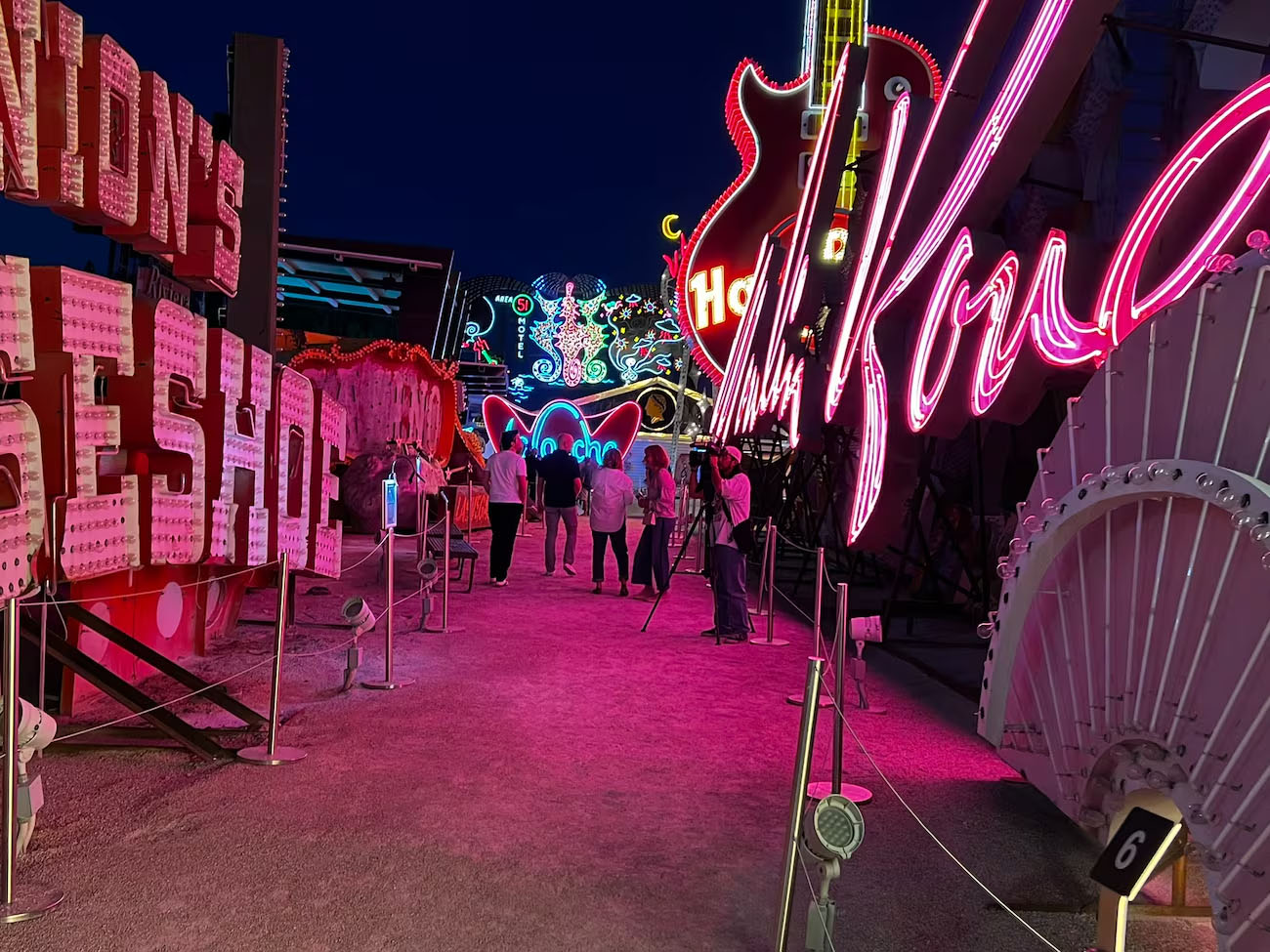
The Neon Museum, a ten-minute walk north on Las Vegas Boulevard, keeps the city's retired signs in an outdoor Boneyard, some restored and lit, most weathered. Tours run $20 to $35 depending on time of day and the after-dark visits are the ones to book; summer daytime visits are brutal. Full guide at the Neon Museum. Both museums are on the north side of Downtown, a short walk from each other and from the canopy, and doing them back to back with a dinner on Fremont East in between is a very good Downtown day.
Fremont East
Where the canopy ends at Las Vegas Boulevard, Fremont Street continues east for six blocks as the Fremont East Entertainment District, and this is the part of Downtown that locals use. The bars are the draw: Commonwealth with its rooftop, the Downtown Cocktail Room hidden behind a nearly unmarked door, Atomic Liquors, licensed since 1952 and the oldest freestanding bar in the city, Corduroy, the Griffin with its fireplaces, Cheapshot for something louder, and a rotating cast of newer places. Cover charges are rare, cocktails run $12 to $18 as of 2026 and the crowd is a mix of residents, service-industry workers off shift and visitors who have found their way out from under the canopy.
Food is good and unpretentious: Carson Kitchen, the small-plates place that started the neighborhood's restaurant scene; Le Thai; a couple of pizza and taco counters; and the food stalls at the Downtown Container Park, a shopping-and-dining complex built from shipping containers with a stage, a treehouse playground for children and a 40-foot fire-breathing praying mantis sculpture out front that performs after dark. The district thins out after 7th Street; stay on the busy blocks. The best bars guide has more.
Other things worth knowing about
- The Golden Nugget's Tank — a 200,000-gallon shark aquarium inside the pool complex with a water slide through it; open to hotel guests, and to non-guests on some days for a fee. Check the property.
- Circa's Stadium Swim — a six-pool, 40-foot-screen rooftop pool amphitheatre open year-round, adults only, with day passes for non-guests. See pools and dayclubs.
- Main Street Station's Berlin Wall — a section of the actual Berlin Wall in the men's restroom, plus stained glass and a brewery. Free.
- Pinball Hall of Fame — no longer Downtown; it is now on Las Vegas Boulevard near the airport, but worth mentioning because people look for it here.
- The Clark County Marriage License Bureau — on Clark Avenue, the reason so many people you meet Downtown are getting married that afternoon. See the weddings hub.
- Downtown Grand and the El Cortez — the two casinos at the Fremont East end; the El Cortez, from 1941, is the oldest continuously operating hotel-casino in the city and its coffee shop is a classic.
Where to stay Downtown
Downtown is the cheapest place in the city to stay in a real hotel, and its rooms have improved a lot. The Golden Nugget is the polished choice, with the best rooms and the pool; Circa is the new adults-only tower with the sportsbook and the rooftop pool; the Plaza, at the head of Fremont Street, has renovated rooms and a rooftop pool; the Downtown Grand is a quieter option a block north; and the El Cortez is the retro one with tiny cheap rooms and character. Rates typically run $50 to $220 a night midweek as of 2026, with weekends higher, and resort fees are generally $30 to $45. Parking is cheap or free with validation at most, a big saving on the Strip.
Everything on this page is within a 15-minute walk of these hotels, which is Downtown's great advantage over the Strip. The downside is the same as ever: the Strip is a $20 to $30 rideshare away, and Fremont Street after 10pm is loud and boozy. The Downtown hotels guide compares them room by room.
Getting there and who it suits
Downtown is five miles north of the Center Strip. Rideshare takes 15 to 25 minutes and costs $15 to $30 as of 2026; the Deuce bus runs 24 hours along the Strip to Fremont Street for a few dollars and is slow but reliable; driving is easy and parking is cheap. Once here, walk: Symphony Park, the museums and Fremont East are all within 15 minutes of the canopy, with the Symphony Park pedestrian bridge linking the west side to Main Street. Do not walk between Downtown and the Strip. The transportation hub covers all of it.
The Downtown described here suits families in the daytime (children's museum, Container Park playground, Neon Museum), culture-seekers (Smith Center, both museums), bar people in the evening (Fremont East), budget travellers and anyone who wants a city rather than a resort. It is less good for people who want everything under one roof and for anyone nervous about street life, which is more visible here than on the Strip. Pair it with the Arts District, a mile south, for the full picture.