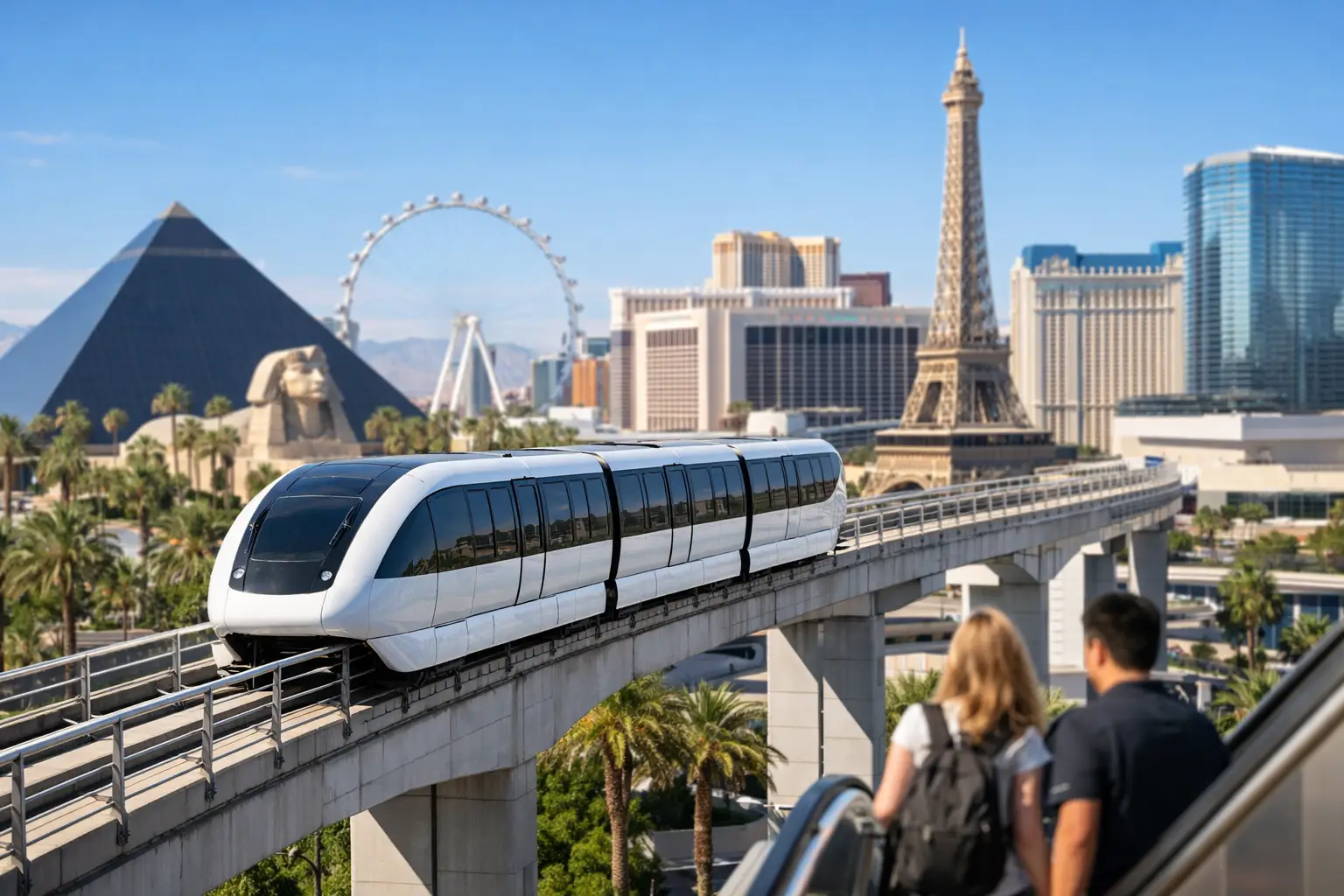
The Las Vegas Monorail can save you from paying surge-priced rideshares for every dinner reservation, show, and casino hop - but only if your hotel and plans fit its route. It is not a Strip-wide subway, and it does not stop at the airport or Downtown. Knowing how to use Las Vegas monorail starts with one practical fact: the stations sit behind the east side of the Strip, often farther from resort entrances than first-time visitors expect.
For travelers staying near a station and moving between the central and north Strip, it is one of the most predictable ways to get around. For everyone else, the walk to reach it can erase the time and money it saves.
How to use Las Vegas Monorail before you buy a pass
The monorail runs roughly 3.9 miles along the east side of Las Vegas Boulevard, from MGM Grand at the south end to SAHARA Las Vegas at the north end. It makes seven stops: MGM Grand; Horseshoe/Paris Las Vegas; Flamingo/Caesars Palace; Harrah’s/The LINQ; Las Vegas Convention Center; Westgate; and SAHARA Las Vegas.
You enter through station gates after buying a mobile or paper ticket, then take an escalator, elevator, or stairs to an elevated platform. Trains run in both directions, so check the platform signage before boarding. The system is straightforward once you are inside. The part that causes confusion is choosing the correct station and allowing enough time to walk between the station and the resort you actually want.
Buy your ticket at a station kiosk or through the official mobile ticket option before approaching the gates. Single rides work for a one-off trip, but an unlimited multi-day pass usually makes more sense if you expect to take three or more rides. Pass pricing and operating hours can change, so verify current rates and the last-train schedule for your travel dates rather than building an itinerary around an old price screenshot.
A pass is not automatically a bargain. If you are staying at Bellagio and spending most of your trip around Bellagio, Cosmopolitan, Aria, and Park MGM, you may walk less by staying on foot. If you are at the Convention Center during the day and headed to dinner around Flamingo, Horseshoe, or MGM Grand at night, the math changes quickly.
Pick the station for your destination, not its name
Station names are helpful, but they can make resorts sound closer than they are. Las Vegas properties are enormous, and the monorail is behind them rather than on Las Vegas Boulevard. Budget an extra 10 to 20 minutes for the walk through a resort, shopping promenade, casino floor, or pedestrian bridge.
MGM Grand station
Use this stop for MGM Grand, the south Strip’s major arena and show traffic, and connections toward Park MGM, New York-New York, and Excalibur. It is a strong choice if you are staying at MGM Grand or attending an event there. It is less convenient for Mandalay Bay, Luxor, and the airport than the map may suggest. For those destinations, a rideshare, taxi, or hotel connection is often more direct.
Horseshoe/Paris Las Vegas station
This is one of the most useful central Strip stops. It works well for Horseshoe, Paris Las Vegas, Planet Hollywood, and Miracle Mile Shops. It can also be useful for a Bellagio or Cosmopolitan visit, but expect a substantial walk involving Strip crossings and resort entrances. Do not choose it because it looks directly opposite Bellagio on a map if you are carrying luggage or trying to make a timed dinner reservation.
Flamingo/Caesars Palace and Harrah’s/The LINQ stations
These are the best stops for a central Strip evening: Caesars Palace, Flamingo, Harrah’s, The LINQ Promenade, and nearby restaurants and attractions. They are especially practical for visitors who want to avoid moving a car or calling a rideshare after drinking.
The trade-off is walking distance inside Caesars Palace. Its footprint is large, and a restaurant or theater may be well beyond the nearest pedestrian connection. Leave early for reservations, particularly on busy Friday and Saturday nights.
Convention Center, Westgate, and SAHARA stations
The Las Vegas Convention Center station is a major advantage for convention attendees staying near the Strip. It can be faster and less stressful than rideshare pickup queues during large events. Westgate is the logical stop for Westgate Las Vegas, while SAHARA serves SAHARA Las Vegas and the north Strip area.
These northern stops are valuable for specific plans, but they are not a substitute for transportation to Fremont Street. The monorail does not go Downtown. From SAHARA, you will still need a rideshare, taxi, bus, or another connection to reach Fremont Street and the Arts District.
Build the monorail into the right kind of day
The monorail is best for point-to-point movement, not spontaneous resort grazing. A smart use case looks like this: start at MGM Grand, ride to the Flamingo/Caesars Palace area for afternoon attractions, walk through the central Strip for dinner, then use the monorail back south after a show. You get the Strip experience on foot without repeating its longest stretches.
It is also useful for splitting up a day. Convention visitors can ride south for a dinner reservation, return north afterward, and avoid rental-car parking charges. Travelers staying at Horseshoe, Paris, Flamingo, Harrah’s, Westgate, or SAHARA can use it as their main daytime transportation and save rideshares for airport transfers, Downtown, and destinations west of the Strip.
Where the monorail performs poorly is the west side of the Strip. Resorts such as Bellagio, Cosmopolitan, Aria, Vdara, Park MGM, New York-New York, and Venetian/Palazzo are reachable from certain stations, but the walk can be inconvenient in heat, heels, formalwear, or after a long day. In those cases, a short rideshare may be worth the premium.
Timing, crowds, and the heat factor
Trains generally arrive frequently, but the full trip from one end of the line to the other still takes time. Add the walk into and out of the stations, and a supposedly quick trip can become 25 to 40 minutes door to door. Compare that total to a rideshare, not just the train ride itself.
The monorail is at its best when traffic is heavy, event exits are clogging pickup zones, or Strip crossings feel punishing. It is less appealing when you need to be somewhere at a precise time and your destination is a long walk from the station. For show nights, aim to arrive in the area at least 30 minutes before you need to be at the venue. That buffer covers station walks, crowds, wrong turns through a casino, and the occasional stop for water.
Summer changes the calculation. An air-conditioned train is welcome, but you still have to walk outdoors or through long resort corridors at both ends. If the temperature is above 100 degrees, choose stations that place you inside or very near your actual destination. Saving a few dollars is not much value if you arrive overheated and late.
What to skip and what to use instead
Skip the monorail for airport transportation. There is no direct airport station. Skip it for Fremont Street, Red Rock Canyon, Area15, Allegiant Stadium, and most off-Strip restaurants. Those trips require another mode anyway, and a direct rideshare or rental car may be more efficient.
Also skip a pass if your itinerary is concentrated in one walkable zone. A couple staying at Venetian who plans to spend a weekend at Venetian, Wynn, Resorts World, and nearby restaurants may get little value from it. A family based at MGM Grand with a Convention Center visit, a LINQ attraction, and a SAHARA meal planned across two days may get real savings and fewer transportation headaches.
The best approach is to map your fixed commitments first: hotel, shows, reservations, convention sessions, and airport transfers. Then count only the monorail rides that genuinely replace a rideshare or long walk. If the route supports those moments, buy the pass and use it confidently. If it does not, spend selectively on direct transportation and keep your Las Vegas schedule moving.